
Complex, Expensive FMS?
There’s a Better Way.
Move away from rigid, high-cost systems and adopt a flexible, modern FMS built for today’s mining operations.
Get Monthly EstimateSee the difference
Takes 20 secs.
What operations actually experience with traditional FMS

High upfront cost
Large capital investment with slow return.

Long deployment timelines
Months (or years) before seeing value.

Low adoption on site
Complex systems that teams don’t use.

Lack of flexibility
Difficult to adapt as operations change.
A different approach to Fleet Management. Commercially Simple. Operationally Strong.
Built to remove the cost, complexity, and delays of traditional Fleet Management Systems.

No Upfront Investment
- Pay per asset, per day
- No charge until “Go-Live”
- No minimum term*
- Fully managed solution (hardware, software & support)

Scalable & Flexible
- Start small, expand easily
- Transferable across assets
- Price aligned to your operation

No IT Burden
- Fully hosted solution
- No on-site infrastructure required
- Works in remote environments

Built For Site Teams
- Simple, operator-first design
- Mobile-first interface
- Developed by the World’s Best FMS Implementers
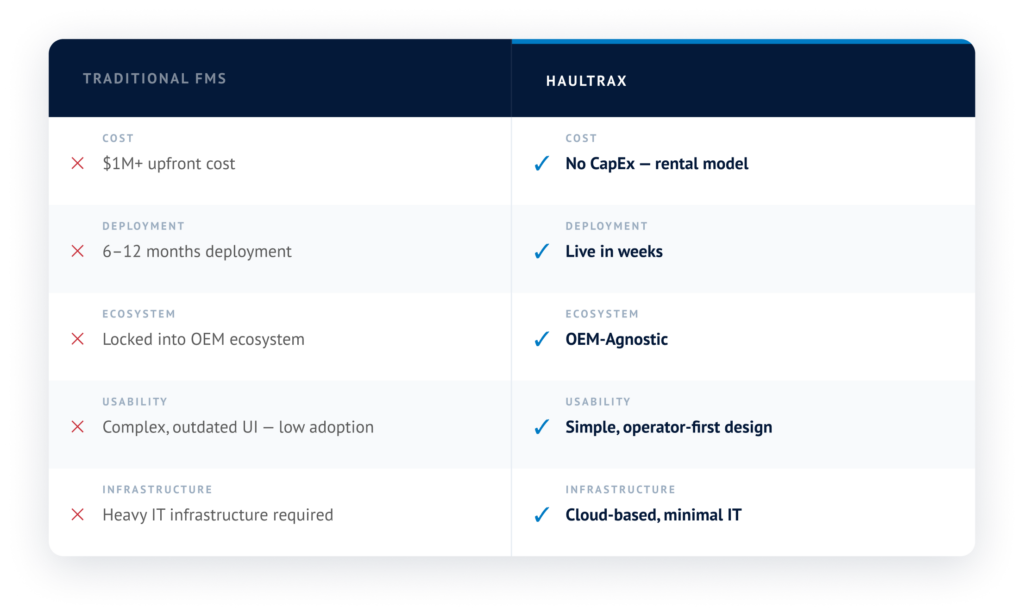
Traditional FMS vs Haultrax
Compare how different approaches impact cost, deployment, and operational performance.
See what this would cost for your fleet




What this looks like on site
Real-time visibility across production, delays, and performance — enabling faster, better decisions on every shift.
Shift Summary
SIC Reporting
Dispatch
Delay Accounting
See shift performance in real time
Track production, material movement, and progress against plan as the shift unfolds – enabling faster decisions and proactive management.
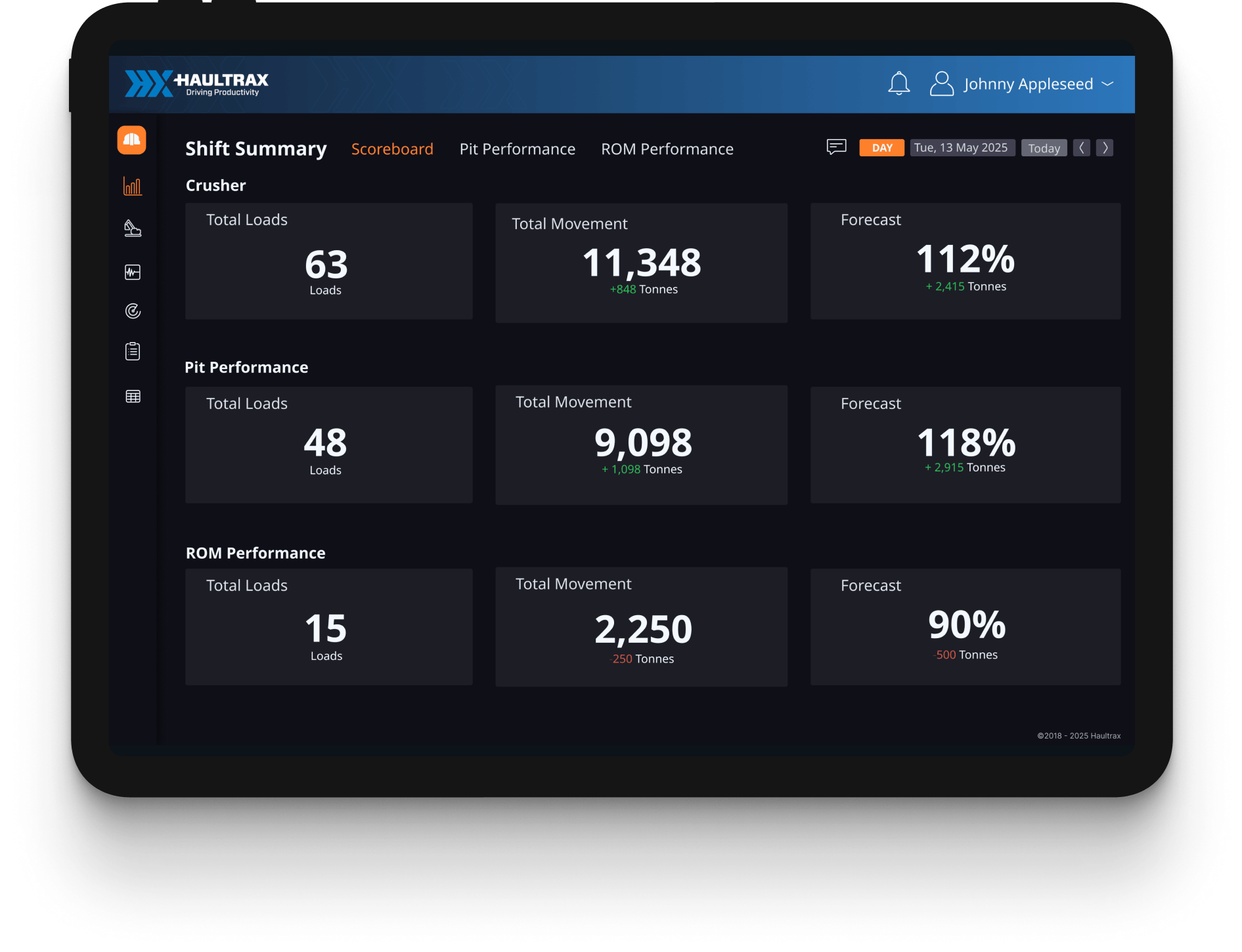
Live visibility into intervals.
Monitor performance in near real time, set clear targets, and adjust execution throughout the shift to stay aligned with plan.

Reduce delays and keep tonnes moving
Coordinate fleet movements in real time to eliminate queues, reduce idle time, and optimise material flow across the operation.

Understand lost time — and prevent it
Capture and analyse delays as they happen, enabling faster response, better planning, and continuous improvement across shifts.

Key questions when evaluating a Fleet Management System
-
What is the difference between rental-based and traditional mining Fleet Management Systems?
Traditional mining Fleet Management Systems typically require significant upfront investment, long deployment timelines, and fixed long-term contracts.
Rental-based models offer a more flexible approach — with no upfront cost, faster deployment, and the ability to scale with your operation.
-
How much does a Fleet Management System cost in mining?
Traditional systems often involve high upfront costs, ongoing maintenance, and long-term commitments.
Modern alternatives offer a subscription-based model — allowing operations to pay per asset, reduce upfront risk, and align cost with production.
-
What should I look for when comparing Fleet Management Systems?
Key factors include cost structure, deployment time, ease of use, and flexibility.
Many operations are now prioritising systems that are quick to deploy, simple for site teams to use, and adaptable to changing operational needs.
-
What internal resources are required to manage a Fleet Management System?
Traditional systems often require dedicated internal resources to manage infrastructure, integrations, system maintenance, and ongoing support — particularly where on-site servers and complex configurations are involved.
Haultrax is a fully managed, cloud-based solution that does not require on-site servers or complex IT infrastructure.
Deployment, updates, and support are all included — allowing your existing team to run the system without the need for additional internal resources.
-
How long does it take to deploy a Fleet Management System?
Traditional systems often take several months to deploy due to complex infrastructure, integration requirements, and phased rollouts across the operation.
Haultrax’s deployment timelines depend on fleet size and site conditions, but the system is designed for rapid implementation.
Installation typically takes 3–4 hours per truck, with 2–3 trucks completed per day, depending on site access and scheduling.