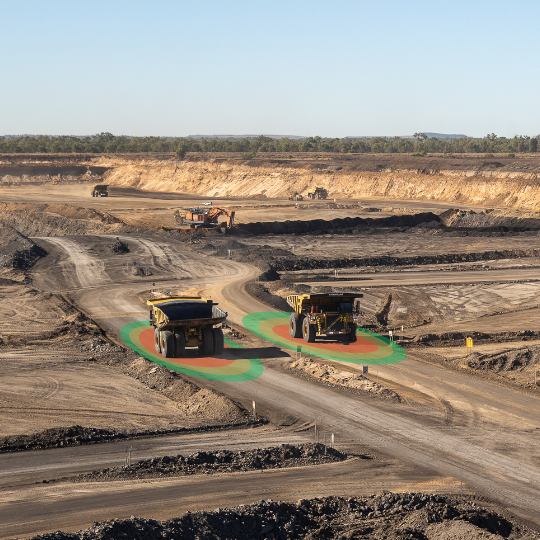
Mining Fleet Management for Modern Mines
E&MJ presents new developments in fleet management systems for open-pit mining operations
Mining Fleet Management for Modern Mines
E&MJ presents new developments in fleet management systems for open-pit mining operations
By Carly Leonida, European Editor
Behind every modern open-cut mining operation is a fleet management system (FMS). Once the preserve of dispatching, today, these software platforms do much more, overseeing the efficiency and safety of every person
and piece of equipment in the pit while simultaneously optimizing their movements and interactions.
While the benefits of deploying a FMS, at an operational level, are undeniable, these systems are increasingly helping mining companies towards their larger corporate commitments, and many of the features and partnerships
announced by technology providers over the past year reflect this.
“The mining industry is increasingly adopting digital technologies to improve efficiency, safety, and productivity,” said Shyamal Sharma, managing director of Haultrax, an Australia-based mining fleet technology and consultancy provider.
“Today, FMS are designed to seamlessly integrate with IoT devices and sensors deployed across mining operations, allowing for real-time data collection and analysis. This facilitates more efficient production, autonomy and degree of predictive maintenance.”
There’s also a growing emphasis on sustainability, with stakeholders pushing mine operators to adopt more environmentally friendly practices. FMS can support these goals by optimizing fuel consumption, reducing emissions, and enhancing energy efficiency.
“These systems help in planning and executing operations that minimize environmental impacts,” Sharma told E&MJ.
“Safety is another paramount concern. Modern FMS integrate with advanced safety systems, such as collision avoidance systems, fatigue monitoring, and proximity detection, to protect workers.” For example, fatigue monitoring can help to identify patterns of behavior in operators that may indicate a driver is fatigued or not adhering to safety procedures. This data can then be used to improve training, better manage shift patterns and ultimately reduce the number of accidents.
The use of big data analytics and machine learning algorithms is also becoming more prevalent in FMS design. These technologies process vast amounts of data generated by mining operations to uncover insights that can lead to operational improvements, predictive maintenance, and strategic planning.
Sharma added: “Other benefits of a FMS include a reduction in human errors: a FMS automates manual tasks, such as data entry, report generation and communication. This reduces the reliance on manual processes that are prone to errors, ensuring accurate and consistent data management throughout the mining operation.”
With today’s real-time monitoring capabilities, FMS provide operators and managers with up-to-date, accurate information on vehicle location, performance, and status. And the sum of all of these benefits are reductions in operating expenditure which contribute directly to the operator’s bottom line.
“By optimizing fleet operations, minimizing downtime, and reducing maintenance and fuel costs, a FMS helps mining companies to achieve significant cost reductions, leading to improved profitability,” said Sharma. “An increase in labour productivity and machine efficiency means that FMS can also help mines to run more efficiently. The data collected by the system can be used to improve the flow of traffic, reduce congestion and improve fleet management.
Having a deeper understanding of how vehicles are being used can also assist with eliminating inefficient processes and identifying misuse of property.”
Haultrax: Making FMS Available for All
Haultrax’s FMS includes the FleetOps module, a solution which uses GPS tracking and intelligent algorithms to compile operational data to enable miners to measure, report and improve on key metrics. The FleetControl module is a dispatching tool which can be layered with this. It compounds the value of FleetOps by allowing the user to act on their data, manage mine plan execution and time, material, and activity tracking.
The solution is a lightweight system that currently only requires an interface for equipment operators. Sharma said a key differentiator for the company is making its FMS affordable for mining companies of all types and sizes.
“The software-as-a-service (SaaS) model cuts out the requirement for expensive and complex IT infrastructure onsite, and FleetControl and FleetOps modules have built-in store and forward capabilities, which remove the need for expensive wireless connectivity,” he told E&MJ. “Our team members all come from a mining operational background. We understand the mining business, operations, its people, and processes and we’re using that to implement technology that delivers value for end users. Our apps are designed around the front-line users, supervisors, operators and dispatchers, and our FMS is built with today’s technology.”
The systems are designed with simplicity and usability in mind. Sharma said it takes only 15 minutes to train any user to operate the app, and reports can be viewed on a phone, tablet, or computer.
FleetOps also leverages automation, requiring no operator input and frees up employees for other activities. He added that Haultrax’s ability to swiftly customize the solution allows the FMS to fit each operation, rather than the operation having to change its ways of working to fit the FMS.
“New functionality can be added flexibly and quickly,” said Sharma. “In the past 18 months, we have been working a lot to add new tailored features for our customers.”
Alcoa’s Willowdale site, located near Waroona in Australia, was Haultrax’s first reference for the FleetOps reporting system, and the full FleetControl FMS has now been successfully rolled out across the site. Prior to this, the mine relied on manual management processes which provided little visibility of team members and assets. Data availability was slow and limited, making it difficult to visualize production rates from a short-interval perspective. For planning and budgeting, inaccurate or deficient data meant that assumptions had to be made and costs would often be over or underestimated.
With the FleetOps deployment, Alcoa has been able to achieve accurate mine plan management and real time productivity accounting, while FleetControl adds value through analysis of production data and insights as to why targets are or aren’t being met.
Change management was an important part of the implementation process, hence the staggered approach to the technology deployment. This allowed the Willowdale team to adjust to the new system and address any challenges be
fore the next level of technology was introduced. Haultrax said the result is that Alcoa has seen benefits in transparency, efficiency and accountability through time, material and activity tracking as well as digital pre-starts for equipment.
Read the full article here.